





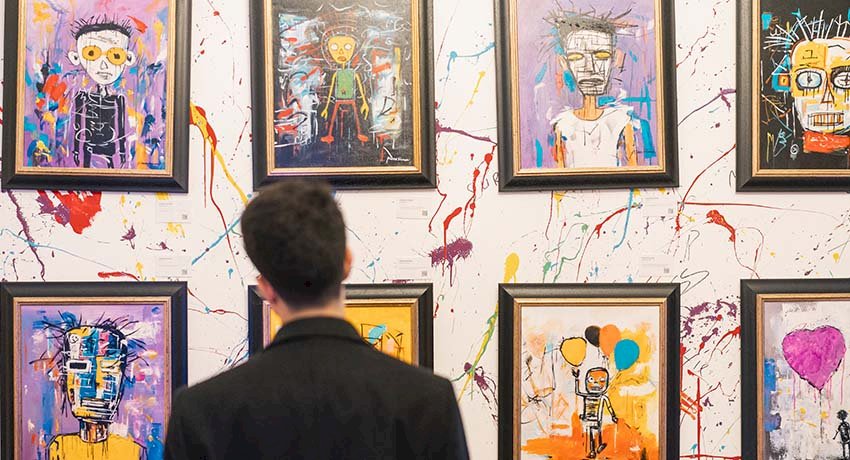
Art is not merely beautiful and expressive; it can also yield financial returns through investment, a feature not observed in many other asset classes. Fine art has long offered portfolio diversification and a hedge against inflation and currency devaluation, often receives favourable tax treatment, and can deliver greater long-term returns.
But it involves a lot of money and can be something only a few can afford, while it requires expertise to collect, which most collectors do not have access to. There is a risk of investing in faulty impressions if you are lured into high-value auctions without considering the risks.
Pablo Picasso’s prints have a significant presence in most print auctions and fetch prices ranging from tens of thousands to hundreds of thousands. Pablo Picasso's ability to reimagine reality has had a profound and lasting impact on modern art.
Pablo Picasso produced numerous works across a range of periods and styles, from the Blue and Rose periods and Cubism to the late cartoon style. His 20th-century masterpieces in graphic art remain compelling investments for collectors and art enthusiasts alike. With its historical rarity, relevance, desirability, market stability, and cultural impact, Picasso's work offers both financial and aesthetic rewards.
Who Was Pablo Picasso and Why His Art Dominates the Global Market?
Pablo Ruiz Picasso (1881-1973) was born in Málaga, Spain, and by age 14, he began studying at art institutions, including the Royal Academy of San Fernando in Madrid. Picasso's art was a synthesis of the avant-garde, revolutionary, and post-impressionist movements, as well as classical and modernist traditions.
He invented or reshaped nearly every major artistic movement of his era, inspiring countless artists and movements, from Futurism to Abstract Expressionism. He was associated with the blue period ( 1901-1904 ), known for monochromatic blue tones, the Rose period( 1904-1906), famous for Rose colour (reds, pinks and orange) palette, and Cubism(developed after 1907), which was a period of rapid experimentation where the artists used multiple vantage points to create images and geometric figures.
Pablo Picasso works include over 20,000 paintings, prints, drawings, sculptures, ceramics, theatre sets and costumes that continue to push boundaries and redefine artistic norms and values. His revolutionary artistic representation conveys myriad intellectual, political, social, and amorous messages.
This period in printmaking is often referred to as Picasso's Neoclassical phase. In the 1940s, Picasso began experimenting with lithography in Paris, producing coloured portraits of Françoise Gilot, his latest lover.
His career was impressive, beginning with printmaking at age 19 in 1899. He continued his work until his final one in 1972, at the age of 90. The size of his works is difficult to estimate accurately.
Still, it is comprehensive, including over 13,000 paintings, at least that many drawings, 2,500 original prints, 1,000 ceramics, and 700 sculptures in other media. His prints and ceramics are generally in editions of 75, which gives a collection of over 250,000 artworks.
What Are Picasso Prints and How Do They Differ from Paintings?
Prints are not cheaper alternatives to paintings; they are distinct artistic expressions with their own market. Picasso created print variations of his paintings, but with significant differences, made them unique works in their own right. Picasso depicted multiple perspectives through various compositions that challenged how viewers perceived form, space and depth.
He produced more than 2,400 prints over seven decades, spanning etching, aquatint, lithography, and linocut, during which he explored diverse visual styles, languages, and narratives. Unlike his paintings, Picasso’s prints were designed to be produced in editions, making them available to a broader audience—yet they remain limited, signed, and historically significant.
Earlier prints could be sold at accessible price points while maintaining scarcity, and now the print edition functions as a financial instrument; in particular, recognised, well-managed print editions by Pablo Picasso can generate substantial income, thereby expanding the collector base.
Why Picasso Prints Remain a Core Asset for Collectors?
Pablo Picasso prints include colourful, fearless, rich, and sharp forms, as well as lithographs, linocuts, and etchings. The factors influencing the value are
- Edition sizes are smaller and hence, are more valuable.
- Hand-signed (Picasso signed prints value) fetches higher prices.
- Condition and provenance improve the value of the prints, though it must be museum-quality provenance.
- Coloured prints often fetch premium prices, and the sensual theme and late linocuts are also valued higher.
- There are multiple accessibility points, from entry-level hand-scribed lithographs for as low as $8,000 to high-end linocuts in the range of $100,000–$1 million.
Picasso prints for collectors feature varied styles and techniques, and provide a portion of a modern master at a more attainable price point. It holds historical value, influences future generations, and has exhibited consistent maturation in the past, making it a long-term, stable investment.
The global art market report finds that from 2020 to 2025, prints appeared in sales auctions and, in 2023, grossed $17 million globally, indicating a long-term bullish trajectory. For example, at the Christie's 'Spellbound: The Hegewisch Collection, Part I' auction held on October 16, 2025, in London, the sale totalled $11.92 m (£8.94m), meeting the pre-sale estimate. Fifty works were sold, totalling $11.92 million, and the sell-through rate was 93% of the original 54 lots announced.
How Limited Editions Increase the Value of Picasso Prints?
Picasso's limited-edition prints are not just about reproduction – they are about creating multiple original artworks that can be valued at accessible price points while ensuring their scarcity is sustained. Picasso limited-edition prints strike a balance in which editions are large enough to generate meaningful revenue but sufficiently restricted to preserve value. The Hand-signed Picasso works are scarce, as they embody the symbols of 20th-century creative genius, making them among the most sought-after even in the year to come.
The system of prints ensures the limited copies are large and in proportion to yield meaningful revenue, but one must buy a Picasso cautiously; matching the print to the verified listings and edition details is essential for authenticity. One must authenticate impressions that are hand-signed in pencil (typically in the lower-right corner) and numbered (e.g., 17/50).
Some prints were only signed in the plate and are less valuable but still collectable. All collectors must consider the basic catalogues raisonnés, such as the Bloch, Baer, and Geiser catalogues, which document Picasso’s graphic work. Most linocuts were Picasso limited edition prints of 50 to 200, with additional artist’s proofs.
The Artistic Themes That Make Picasso Prints Timeless
Some of the artistic themes found in Picasso prints that are timeless are -
- Picasso’s linocuts are from a narrow window in the late 1950s and early 60s. For example, Buste de femme au chapeau, from 1962, shows Picasso at his jazziest, using more decadent colours in his printmaking.
- He used innovative techniques, experimented with shapes, and created from his early Blue and Rose Periods to his groundbreaking Cubist works, reflecting a dynamic body of work that continues to inspire the new generation of artists. He mirrored art in the political and social environment and layered it to resonate with contemporary audiences.
- He used multiple styles, ranging from realistic portraits to transform viewers' perceptions and trigger emotional responses beyond time and cultural limitations. His abstract compositions, spanning a broad spectrum of tastes, remain a continual source of learning, motivation and admiration.
- Pablo Picasso prints have enormous historical significance and visual impact, making them highly desirable for collectors. Le repas frugal, his most famous etching from La Suite des Saltambiques, sold for £6 million at auction in 2022, setting a record for a Picasso print.
- A series is The Vollard Suite (1930–37), commissioned by Parisian art dealer Ambroise Vollard. It features etchings inspired by Greek mythology, the Minotaur, and Picasso’s artistic alter ego, blending neoclassical influences with surrealist tones. Although it initially included a full portfolio, many of the 300 printed sets have since been divided, making complete sets exceptionally valuable. In 2019, a complete set sold for £3.75 million.
- Pablo Picasso linocuts are valued exceptionally for their vibrant colours and technical expertise. In the most recent auctions, Buste de femme d’après Cranach le Jeune (1958), a multicoloured linocut, sold for $127,000, 111% above its $60,000 low estimate (Christie 2025), emphasising the high desirability of these prints. Picasso’s linocuts are especially prized for their layered, unique technique, which makes each print virtually distinctive and unrepeatable.
How Picasso Prints Perform as Long-Term Investments?
A survey by Artprice finds that Pablo Picasso continues to dominate the print market, particularly in the segment where annual turnover consistently exceeds £10m over the decade. In recent years, the print market has been stable and performed strongly; even in 2023, print sales were higher.
The lot volumes have grown in the short term from 1,549 in 2020 to 2,107 in 2024, a 36% increase, indicating increased dealer and collector appeal. Limited edition prints show a remarkable resilience because they are Picasso blue-chip artist prints that bring income with security and liquidity levels unlike other artworks, confirming Picasso prints ' long-term value in the print market.
The Role of Authentication and Provenance in Picasso Prints
Authentication and provenance in Picasso prints are required not only to determine the actual investment value but also to defend the legitimacy of the work. Reselling a fake, even unknowingly, can harm your reputation as a collector or dealer. Authenticity has become increasingly complex, particularly due to the presence of forgeries and fakes, as well as undocumented works.
Under French law, the Picasso Administration, overseen by the artist’s family, Picasso's heirs, held the moral right to authenticate his works, and this allowed them to issue certificates of authenticity (COAs) based on their understanding of his compositions.
The heirs formed a committee to handle authentication. Still, disputes have led to its disbandment, and the number of Picasso forgeries has grown, complicating the process for dealers and sellers, who often require dual authentication to assess the investment value of Picasso portraits and prints.
Additionally, one must ensure the artwork is listed in the Picasso Catalogue Raisonné, or the Picasso blue chip artist prints listings, and one must obtain detailed documentation and consult multiple specialists and professionals to assess Picasso prints' long-term value with accuracy, significantly boosting the value of Picasso prints for sale.
Why Picasso Prints Are Ideal for New and Experienced Collectors?
Pablo Picasso prints have a global reputation. All his paintings and prints are famous for their versatility and creativity. Art lovers and collectors can diversify through the prints.
The prints are considered emblems of cultural history and were part of famous private collections or reputed museums, which has ensured the scarcity of the work available on the market; supply remains low, thereby increasing demand and adding value to subsequent resales. Picasso’s works across various fields have shown relative stability in the past, which gives investors confidence.
For most emerging collectors, Picasso’s prints have been a goal investment because they are known for rarity, and affordability as compared to paintings (compared to paintings), and their market is expected to grow on consistent demand, especially from institutional collectors and major galleries.
Amid economic instability, the art market has emerged as a beacon of success, transforming other sectors. Picasso prints for collectors are a traditional investment that recovers during an economic cycle.
How to Identify Valuable Picasso Prints Today?
To estimate Picasso prints value, one must see the following factors-
Edition size - It is one of the most significant factors influencing a print’s value. Picasso’s works range from trial proofs to editions in the hundreds. Smaller editions are desirable because they suggest greater exclusivity.
States of print – One can find variations in the same print as the artist refines the work; Picasso often experimented with multiple states, especially in linocuts. He used multiple colour layers that employed new carving and printing processes. It shows the early states or proofs carry a premium.
Provenance and condition play a crucial role in determining the print's actual value. Since prints are produced on paper, they are more susceptible to damage than paintings. Collectors must look for well-preserved works, ideally with a clear provenance record, authentications, and one that can trace the history of Picasso prints back to reputable galleries, museums or auction houses to authenticate documents.
One must match the print to the Picasso limited edition prints listings to verify authenticity and edition details. Picasso primarily used high-quality papers such as Arches wove or Japon nacré. Experts must assess the original condition of Picasso's prints, the quality of Picasso imaginary portraits, which greatly affects value, and avoid foxing, staining, or rips. Original paper colour, deckled edges, and clear margins enhance demand.
Authentication must be done for Picasso’s linocuts, which are bold and emotionally charged, demonstrating the creative work. The prints are Bloch, Baer, and Geiser as per the catalogues raisonnés that document Picasso’s graphic work. To get an authenticated edition, match the print to the listings to verify authenticity and edition attributes.
Picasso linocuts have gained considerable traction over the past decade; however, the value of an investment depends on the subject, colour, and condition. Colour portraits of Jacqueline, for example, are especially sought after and have become cornerstones of museum and blue-chip private collections.
Are Picasso Prints Still a Smart Investment in Today’s Market?
Picasso prints are often cited as an entry point for a smart investment in the art market, and they have been recommended for diversifying your portfolio and increasing your wealth. The Picasso prints market continues to be volatile despite its age and maturity.
One must carefully assess all features of the prints available at public auctions and build on a sustained institutional presence in museums. The Picasso limited edition prints satisfy collectors' requirements, and these are clearly documented, widely exhibited, extensively covered by documents and literature, and well represented in the leading museums.
It is historically and culturally relevant, and investors prefer the familiarity, abundance and track record of the paintings.
FAQ:
Why Are Picasso Prints So Valuable to Collectors?
Pablo Picasso prints are valuable to collectors because of the power of the images themselves. Picasso’s linocuts are bold, experimental, and emotionally charged—carrying the full force of his creative genius.
Are Picasso Prints Considered Original Works?
Original Pablo Picasso prints are not reproductions. Yes, there are original Picasso prints, but one must authenticate the work and obtain certificates of authenticity and documentation to verify authenticity.
Do Signed Picasso Prints Hold More Value?
Yes, a limited-edition, signed, original, authenticated Picasso prints hold more value.
Are Picasso Prints a Good Investment for Beginners?
Yes, Original Picasso prints are highly sought after for the historical value of Picasso prints and creative aspects. They offer a compelling means of investing in historically significant art.
How Can Collectors Authenticate Picasso Prints?
The assessment process for Picasso prints for collectors starts with a preliminary examination by a Pablo Picasso specialist, which traces the artwork's ownership history of Picasso prints through documents and exhibition records.
Will Picasso Prints Continue to Increase in Value?
Picasso prints may continue to increase in value, but understanding the nuances of Pablo Picasso prints is crucial for collectors. One must evaluate the investment's robustness and invest in authentic prints.
