



Perspective is a fundamental component of drawing that gives the picture a sense of three–dimensionality, which is essential for creating believable scenes in all types of art, whether still life, portraiture, animal, or interiors.
One-, two-, and three-point perspectives rely on straight lines to show three-dimensional space and forms. The 2 point perspective is the most commonly used in construction methods for artistic and architectural work.
The two dimensions of recession and the primary form, from countless points of view in a 2 point perspective drawing, make the framework suitable for all landscapes, architectural situations, and portraits.
2 (two Point Perspective: Complete Beginner’s Guide with Easy Step-by-Step Drawing
Perspective describes how colours change with distance, making an object appear smaller as the distance increases. It explains that objects appear less detailed when they are farther away (Leonardo Da Vinci).
The central, or one-point, perspective presents a static, symmetrical view of space and objects, emphasising central recession and the recession of perspective gradients, with the edges of forms coinciding. Two point perspective depicts a turning or moving aside, a look to the left or right.
What Is 2 Point Perspective? Definition, Examples & Drawing Techniques
The two point perspective approach to the primary form is informal, complex, and idiosyncratic, treating two adjacent sides of the object as a single perspective. The view is associated with the orientation of objects that are angled relative to the image.
Two point perspective keeps vertical lines parallel while converging the horizontal lines toward two different points, preventing the distorted “falling over” appearance of tall structures and helping establish reliable spatial relationships in complex, angled scenes.
The two point perspective arises from the direction of view – the sideways view that is not perpendicular to the primary form. The sideways, idiosyncratic, and intimate views expand the range of pictorial effects that the perspective image can create.
The most common example of 2 Point Perspective is the corner view of a building, where one side moves toward the left vanishing point and the other toward the right vanishing point.
The city streets and roads on both sides converge toward two points on the horizon, creating a 3D effect.
The other examples are interior room scenes, which show a room from a corner angle, with furniture and walls aligned with the two points; the desk, box, and chair, placed with the corner of the room facing the viewer, are in 2 Point Perspective.
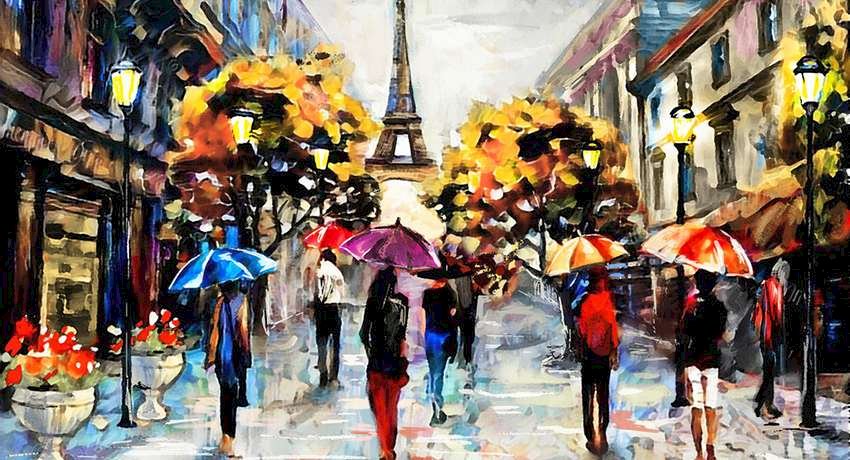
The urban landscape scene depicting a street where buildings, sidewalks, windows, and other areas fade into the left and right is an example of two point perspective.
Key Elements of 2 Point Perspective Drawing
The key elements of 2 Point Perspective drawing are
Linear perspective – The linear perspective technique represents three-dimensional space on a flat surface.
Vanishing points – The point in space where items seem to disappear. Lines converge on two vanishing points. Two vanishing points are located on the horizon and are often outside the drawing area, appearing near or at the edge of the paper where it is created.
Receding lines – The horizontal lines converge towards the left or right vanishing point.
Vertical lines – The vertical lines, unlike the horizontal lines, are straight lines which are drawn from top to bottom, and they remain straight up and down. The vertical corners of the drawing are perfectly vertical.
These Horizontal lines – The straight lines drawn from side to side or at eye level as the horizon line. The horizon or the eye level represents the viewer’s eye level, where sky meets ground. The object drawn above the horizon line is viewed from below, and those below the horizon are viewed from above. All horizontal lines, parallel lines must aim towards one of the two vanishing points.
Orthogonal lines - The orthogonal lines are parallel lines that converge on the vanishing point. Also, there are Construction lines, light lines drawn from the object to the vanishing points to establish perspective.
Step-by-Step Guide to Draw 2 Point Perspective
To draw a 2 Point Perspective, follow the steps
- Draw the horizon line in the middle across the paper to represent the viewer’s eye level.
- Mark the two points on the horizon line near the far left and the right edges of the paper.
- Draw a single vertical line between the vanishing points (VPs) that represent the closest edge of the object to form a corner edge.
- Use a straight edge to connect the top and bottom of the vertical line to both the left and right vanishing points.
- Draw a vertical line on the left and right sides to indicate the endpoints of the objects.
- To create a closed cube, join the top corners of the new vertical lines to the opposite VPs.
- Darken the main object lines and remove the construction lines that extend to the VPs.
2 Point Perspective Drawing Examples
Architectural exterior/interior - The architectural exterior, such as the street-corner view of Times Square Corner, where the buildings on both sides seem to recede toward vanishing points on the horizon, is an example of 2PP. Close buildings appear wide and detailed, while distant buildings appear narrower and tighter. The interior of the rooms, looking at a corner where the two walls meet, represents a 2PP room.
Vehicle- Car, or tram drawings often have one vanishing point that defines the front, and the other represents a side of a perspective art.
Objects- Everyday objects such as cubes, boxes, and furniture placed at a certain angle where the corners are close to the viewer’s eye represent perspective art.
Letters- The two point perspective letters show a front and side face with all the horizontal edges converging to the left or right vanishing point.
Some examples of 2 Point Perspective Drawing are
Leonardo da Vinci's The Last Supper (1498): Leonardo used a two point perspective technique, evident in the famous painting, which shows the architectural setting and depth within the scene.
Sandro Botticelli's The Annunciation (1485- 1492): It shows the Angel Gabriel delivering God's message to the Virgin Mary, where the architecture and spatial perspective create a three-dimensional effect through two vanishing points.
Gustave Caillebotte’s Paris Street; Rainy Day (1877) - It is a 2 point perspective that uses two distinct vanishing points to create converging buildings, figures, and wet streets.
Albrecht Dürer’s Unterweisung der Messung (1525) - It is one of the earliest documented 2PPs, demonstrating the technique.
William Hogarth’s The Marriage Contract (c. 1743) - It shows the interior scene to create a realistic, angled view of a room.
Hendrick van Steenwijck the Younger’s architectural paintings are known for their precise interiors of churches, where two point perspective is used to depict depth, and exteriors.
Rembrandt’s A Woman Sitting Half-Dressed beside a Stove (1658) – It is a 2 point perspective drawing displaying a close-angle interior perspective.
Cornelis Bisschop's Drawn Studio Scene (c. 1654/58) - It is a detailed, drafted 2 point perspective drawing that accurately shows perspective in an interior setting.
2 Point Perspective Buildings
Some 2 point perspective buildings examples are
City street Corners – The intersection of one building side receding left and the other right - is one of the examples of a 2PP.
Skyscraper corner view – A low–angle view of a building's height from a corner near the viewer’s eye gets a 2PP.
Suburban house – The 3D representation of a house's front and sides is often used in residential or office architectural sketching.
Residential blocks with windows- Rectangular structures are basic blocks used in such 2 point perspective buildings, where all the horizontal edges of windows and doors are aligned to the vanishing point.
2 Point Perspective City
Examples of 2 point perspective city views are given here.
The street corner view is a 2 point perspective city example that features the single corner of a building close to the viewer's eye, with the sides receding to the left and right Vanishing Points.
In a 2 point perspective city, two roads intersect at a scene, with roads crossing buildings at the corners, creating an urban canyon effect where lines converge to the left and right.
A residential street scene where all the houses and buildings recede into the distance along a curved or straight street, with two vanishing points determining the roof angles and wall alignments, is an example of 2 point perspective city.
The narrow view of an urban alleyway, showing the side of a building, its windows, and doors, follows the perspective lines.
Common Mistakes in 2 Point Perspective (And How to Fix Them)
Common mistakes in 2 Point Perspective drawings and their fixes are listed here.
Distortion – The mistake occurs when the vanishing points are too close together, resulting in a wide-angle effect. To solve the issue, the artist must position the vanishing point outside the drawing area.
Misalignment – When the lines do not meet at the correct vanishing point, it leads to misalignment in landscape perspective drawing. The lines are not reaching the vanishing point where more than one line goes to the wrong vanishing point. The artist must use a ruler and lightly sketch the lines to the vanishing point to ensure convergence.
Inconsistent scale - The objects must adhere to a consistent scale, meaning they recede into the distance and appear smaller to maintain the illusion of depth. The characters must fit the environment and not appear too small or too large relative to other objects.
Depth – The closer you go to the horizon, the thinner the depth of the object must be. Even the repeating depths are mistaken by the beginners. Sometimes the objects have no depth or finish, which is a perspective error. Sometimes, the central landscape perspective drawing is exaggerated or misplaced, and vanishing points lead to exaggerated perspective.
Floating/unstable objects – The use of non-aligned objects with the horizon can create objects that appear to float; hence, the artist must establish the horizon line first, which shows everything above its bottom and below its top.
Distorted vertical lines – If vertical lines are tilted, the landscape perspective drawing becomes distorted. It should be straight up and down, perpendicular to the horizon line.
Improper proportions – Inaccurate proportions can lead to perspective errors, where objects may look either too small as they recede or stretched. Use proper proportions to establish accurate diminishing spacing for landscape perspective drawing objects moving towards the vanishing point. For instance, planes meet in awkward ways, either with the Horizon Line or with each other; it looks constructed.
Lines with no width variations – The lines give a sense of depth by varying their width. Closer objects have wider lines, and farther-away objects have thinner lines.
Vanishing points too close to the edges – Placing objects too close to the VPs causes distortion. It is advisable to keep the main subject between the vanishing points, not near the edges.
Object disappearing – When the object is placed on the horizon line, it can appear different if the top or bottom faces are drawn. One must understand that the object on the horizon line must appear flat in the landscape perspective drawing, with only its sides visible. Complex shapes – Drawing complex shapes in 2PP can be challenging. Getting accurate angles and curves can be tricky.
Tips to Improve Your 2 Point Perspective Skills
Start the 2 Point perspective drawing by establishing the horizon line and placing the two vanishing points on the line. Place the vanishing points outside the drawing area to prevent distortion. Use realistic references of people and buildings to depict real-life scenes.
The most common mistake is angling vertical lines, which must remain perfectly perpendicular to the horizon. Position the horizon line based on the desired viewpoint, high for a bird’s eye view, low for a worm’s eye view and middle for standing height.
Make the background lines thinner and the foreground lines thicker.
One must avoid scale inconsistencies in landscape perspective drawing that disrupt the illusion of depth. Placing too many elements in a landscape perspective drawing can make it appear cluttered and less effective in conveying depth.
Do not try to draw freehand; always use guidelines and set up your initial structure with scales and rulers to create a landscape perspective drawing.
2 Point Perspective vs 1 Point Perspective
One point is simpler, and two points are complex to draw.
One-point perspective makes the viewer feel they are standing in the front, and two point perspective makes them feel they are standing on a side or a corner.
In one-point perspective, the artist draws a single point on the horizon line; in two–point perspective, the artist draws two separate points on the horizon line.
In one-point perspective, all perpendicular lines converge at a single point, while vertical and horizontal lines remain straight. In 2PP, the vertical lines remain vertical, while all horizontal lines recede toward one of the two vanishing points.
In one point perspective cubes, lines are perpendicular, and in two–point perspective, they become diagonal lines that run towards the vanishing points.
One-point perspective is used for drawing room interiors, railway tracks, or straight roads, and two point perspective is used for buildings, cityscapes, and street views from an angle or at the corner of a street.
Tools & Materials Needed for Perspective Drawing
The tools and materials needed for perspective art are
Drawing surface such as large sketchboards, standard paper pads, a pencil, a ruler, and an eraser, drafting tools, t-squares, and triangle rulers to make precise horizontal, vertical, and diagonal orthogonal lines.
You need low-tack artist tapes to find the paper, and 10-point dividers and perspective grids can be used for complex drawings.
One can create such a drawing by using digital tools and specialised apps.
Applications of 2 Point Perspective in Real Life
Architecture designs (Interior space/Exterior space) – Perspective art is used to design interior spaces, including the placement of furniture, floors, and windows in residential and official spaces, with accurate proportions relative to other objects in the rooms. The exterior perspective shows how a building will appear from a street-level angle.
Urban sketching or landscape art: The artist uses perspective art to depict a quiet street corner, making the scene with buildings and roads appear realistic, with depth between the buildings and the surrounding environment.
Film sets– Detailed 2 point perspective drawing are used in film sets or theatrical stages to depict dramatic or scenic depth or movement across streets or rooms.
Product design - The illustrations of 2 point perspective drawing can be applied to realistic product design.
FAQ
What Is 2 Point Perspective in Simple Words?
2 point perspective drawing uses two vanishing points on the horizon to create a 3D effect: horizontal lines converge to the vanishing points, while vertical lines remain straight.
Why Is 2 Point Perspective Important in Drawing?
2 point perspective drawing resembles how the human eye sees the world, providing better depth perception and allowing artists to depict objects from a distance, above, below, or at different angles.
What Is the Difference Between 1 Point And 2 Point Perspective?
One-point perspective uses a single vanishing point to create a focal, head-on view, as if looking at the flat face of the object. 2 point perspective drawing uses two vanishing points to view objects, like buildings, from a corner, creating an angled, or 3D, effect.
How To Draw 2 Point Perspective?
2 point perspective drawing can be used to design rooms or buildings. Start by drawing a horizon line and placing the two vanishing points on each end. Draw a vertical line below the horizon line and then a straight line from the top of the vertical line to each vanishing point. Then draw a straight line from the bottom of the vertical line to the vanishing point, and then draw two more vertical lines between the diagonal lines that run from the first vertical line to the vanishing point. Then draw another line from the new vertical line to the vanishing point, and then bold the “box” shape in the middle.
Is 2 Point Perspective Hard for Beginners?
A 2 point perspective drawing is considered more challenging than 1-point perspective for beginners because it requires managing two vanishing points on the horizon line instead of one; however, it is accessible once the basic rules for setting a horizon, establishing two vanishing points, and drawing vertical lines are understood.
Where Is 2 Point Perspective Used?
2 point perspective drawing is used to create an illusion of three-dimensional space on a two-dimensional surface in which box line forms are seen from an angle with two visible sides that recede to one of the two vanishing points on the horizon, for example, street corners, complex architectural interior and exterior designs and city street views.
How Do You Draw Buildings In 2 Point Perspective?
To draw buildings in two point perspective –Establish the horizon line and mark the two vanishing points near the edges of the page, draw the leading corner and connect the top and bottom of the vertical line to the left and right vanishing points to form the guidelines for the building walls and then draw two vertical lines on either side of the leading corner to determine the extension of the walls.
How To Draw a Cube In 2 Point Perspective?
- To draw a cube in 2-point perspective, draw a horizontal line and place two vanishing points far apart on the line.
- Draw a vertical line between the two vanishing points, closer to the horizon, and draw light lines from the top and bottom of the vertical line, which are the left vanishing point and right vanishing point.
- Draw two more vertical lines on the left and right to determine the width and depth of the cube, and then connect the top of the left side line to the right vanishing point and the top of the right to the left vanishing point to create the top surface.
- Darken the visible lines.
How To Draw a Room In 2 Point Perspective?
- To draw a room in two point perspective – set up the Horizon line and the two vanishing points at the opposite ends of the line.
- In the middle of the paper, draw a vertical line that represents the corner closest to the viewer.
- From the top and the bottom of the vertical line, draw the diagonal line to the left vanishing point and the right vanishing point.
- Draw two vertical lines where you want the side walls to end, and connect the new lines to the opposite vanishing points to define the corner where the ceiling, floor, and walls meet.
- Add furniture and other details, and connect all furniture's horizontal edges to the same vanishing points.
- Erase unnecessary vanishing lines and horizon line.
How To Draw Letters In 2 Point Perspective?
- To draw two point perspective letters, first draw a horizon and two vanishing points on the left and on the right.
- Draw a vertical line connecting the top and bottom of both vanishing points; it forms a box for the letter.
- Sketch the letter within the box and ensure all the vertical elements remain vertical and horizontal as the top converges to a vanishing point.
- From the corners, draw lines back towards the opposite vanishing point to create depth.
- Erase unnecessary construction lines and shade the letter sides.
