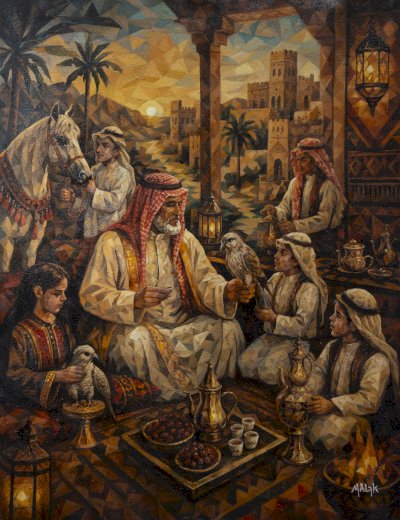


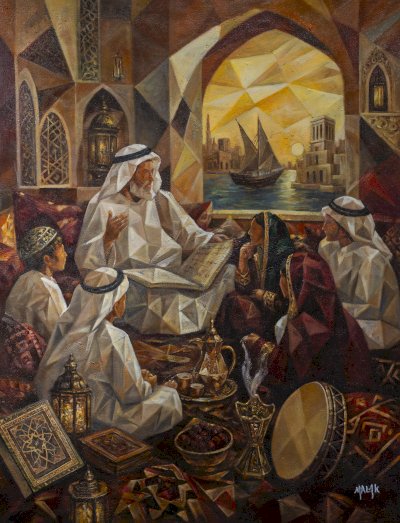



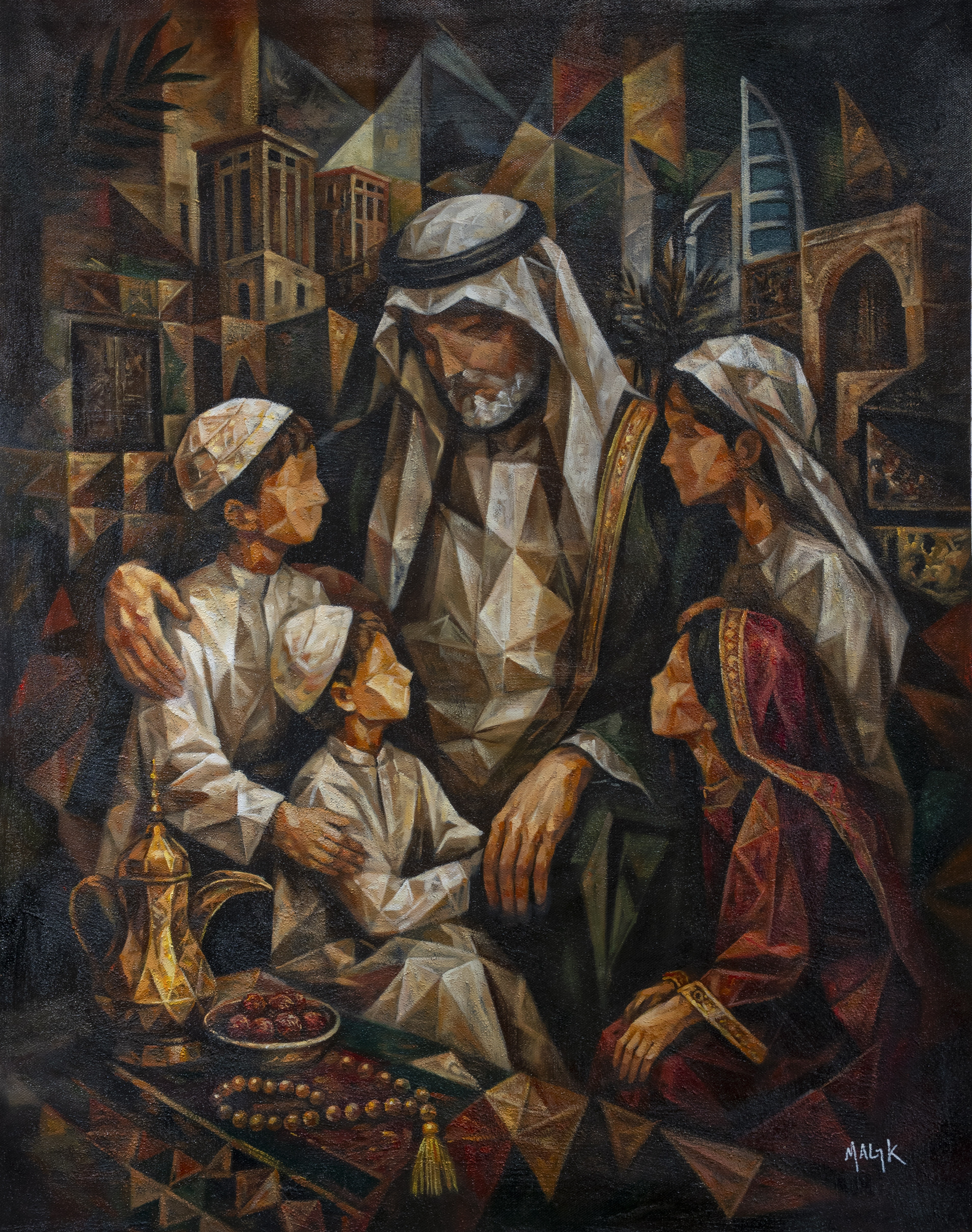
Malak's United Arab Emirates composition centres upon a dignified
grandfather surrounded by his grandchildren. His body forms the
emotional architecture of the work — protective, composed and
quietly authoritative. Around him, the familiar rituals of Emirati
hospitality become mechanisms through which cultural knowledge is
passed onwards.
A dallah, coffee cups and dates occupy the domestic space, while prayer
beads introduce another intimate inherited object and subtle Al Talli
detail provides a specifically Emirati decorative language. Both Arabic
coffee traditions and Al Talli embroidery have been recognised by
UNESCO. Their importance to the work lies not simply in heritage
status but in their method of transmission: coffee carries codes of
generosity, welcome and social etiquette, while Al Talli has traditionally
been taught through generations of women.
Historic barjeel architecture, carved screens and palm gardens frame
the family. A restrained contemporary skyline may appear in the
distance, but modernity is deliberately kept secondary. Malak is
interested less in the spectacle of transformation than in the people
who have lived through it.
Emirati sand incorporated into the surface gives this relationship
particular resonance: beneath the rapidly changing urban landscape
remains the physical ground upon which earlier generations built their
lives. The work's central proposition is a simple one.