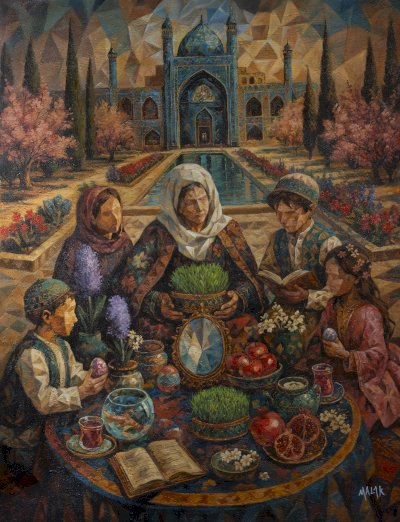





One of the featured works of Series 6, Malak's Iranian composition is
constructed around Nowruz, renewal and the Persian garden. A
grandmother, or family matriarch, occupies the garden alongside
younger generations. Around them, spring appears almost ceremonially:
hyacinths, sabzeh, pomegranate and cypress emerge among
turquoise architectural surfaces, water channels and geometrically
ordered planting.
The setting draws upon the chahar bagh tradition of the Persian garden,
where water, architecture, planting and geometry create an
environment that is at once physical and contemplative. Within this
space, Malak introduces the symbolism surrounding Nowruz. Rather
than crowding the work with ceremonial objects, he treats renewal as an
atmosphere: reflected light, flowering plants, colour, abundance and the
presence of family.
Persian carpet geometry quietly echoes the garden's structural order,
while a mirror or book of poetry becomes the inherited object within
the composition — connecting domestic ritual to Iran's extraordinary
literary tradition. Iranian sand anchors this world of water and
flowering vegetation to the earth beneath it.
Spring Enters the Garden is ultimately concerned with recurrence.
Seasons return. Families gather again. Rituals are repeated.