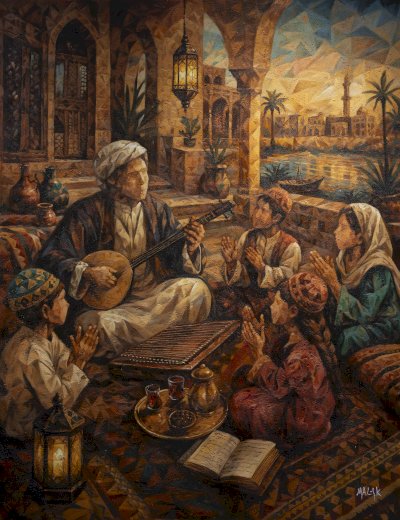





Music becomes the connective force between generations in Malak's
Egyptian composition. An older musician plays the semsemiah among
children and family beside the Nile, turning the riverbank into a place
of gathering, humour and shared learning.
Rather than leaning upon the monumental imagery that has so often
defined representations of Egypt, Malak focuses upon a living musical
tradition. The semsemiah is particularly significant: its crafting and
playing were inscribed on UNESCO's Representative List of the
Intangible Cultural Heritage of Humanity in 2024, recognising a
practice closely associated with weddings, festivals, communal
celebration and the transmission of knowledge between generations.
Around the figures, Malak layers different periods of Egyptian
civilisation without allowing any one era to dominate. Cairene Islamic
architecture, Coptic references and ancient forms coexist within the
composition, suggesting a country whose cultural identity has
accumulated across millennia rather than belonging to a single
historical moment.
Papyrus, lotus, date palms and Nile water introduce the natural
landscape, while lantern light and woven textile geometry draw the
scene back towards domesticity and human gathering. Egyptian sand is
integrated into the surface itself.